
Gamifying Engagement in Spatial Crowdsourcing: Lessons from a Campus Field Experiment
Citizen science has transformed how environmental and urban data are collected. Thanks to mobile devices and digital platforms, volunteers can now contribute observations at a scale that would be impossible for traditional research teams alone.
Yet, most citizen science projects face a persistent challenge: participation declines over time. Initial enthusiasm often fades, leaving only a small group of highly active contributors. This drop in engagement can create gaps in geographic coverage and may affect data quality.
Our recent study published in Systems (MDPI, 2025), explored whether gamification could help address this challenge in spatial crowdsourcing contexts, particularly when participants are collecting geolocated observations in real-world environments. The research examined how specific game elements points, daily streaks, and real-time leaderboards affect motivation and engagement among university students participating in a citizen science experiment.
Why Gamification Matters in Citizen Science
Citizen science platforms frequently rely on volunteer participation for data collection. However, when tasks become repetitive or when feedback is limited, participants may lose motivation.
Previous research suggests that gamification defined as the use of game design elements in non-game contexts, can strengthen engagement by providing feedback, goals, and social comparison mechanisms. The theoretical model underlying this study connects game mechanics to psychological needs (competence, autonomy, relatedness) and from there to behavioural outcomes such as sustained participation and data quality.
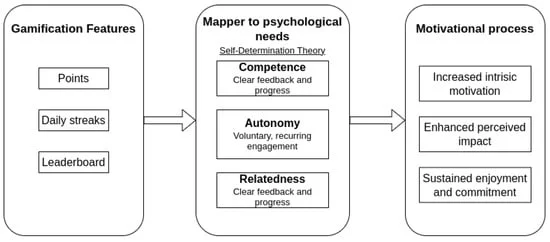 Conceptual model linking gamification mechanics to psychological needs and behavioural outcomes.
However, the evidence remains limited for location-based citizen science, particularly in real-world field settings. Many previous studies have focused either on purely digital environments or on platforms that lack controlled experimental evaluation.
This study aimed to fill that gap by examining how gamification operates during a real-world spatial data collection experiment.
A Five-Day Campus Experiment
To investigate these questions, a five-day field experiment was conducted on a university campus using a gamified spatial crowdsourcing platform that integrates the GREENCROWD web application with a modular gamification engine called GAME (Goals And Motivation Engine). The platform allowed for the creation of geolocated tasks, real-time feedback, and adaptive incentive structures.
GREENCROWD allowed participants to see active points of interest (POIs) on a map, each with associated point rewards. Students could select any POI and get directions to reach it, turning data collection into a location-based activity across campus.
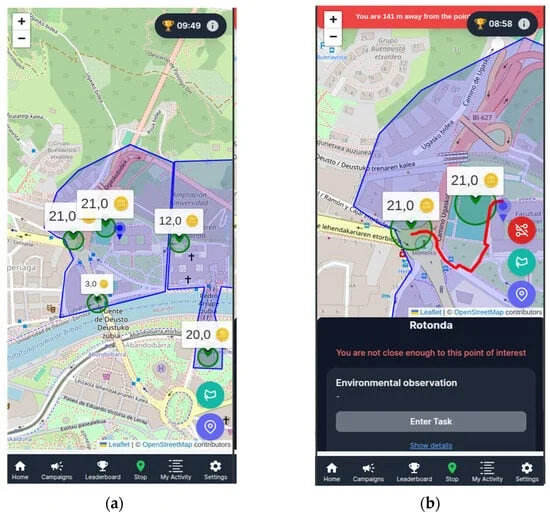 GREENCROWD map interface showing active POIs with point rewards (left) and route creation to a selected point (right).
How Tasks Were Structured
Each task required students to complete three stages at a given location:
- Environmental perception ratings: evaluating conditions at the spot
- Geotagged photo submissions: uploading a photograph tied to the location
- Engagement intent indicators: noting intentions and suggestions for improvement
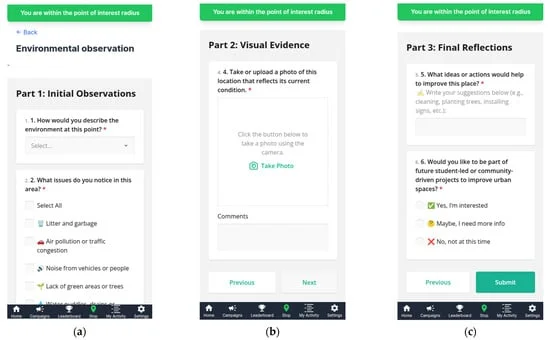 The three-stage task flow: perception ratings (left), geotagged photos (centre), and engagement suggestions (right).
After completing all stages, participants submitted their responses and received immediate point feedback a key moment designed to reinforce the sense of accomplishment.
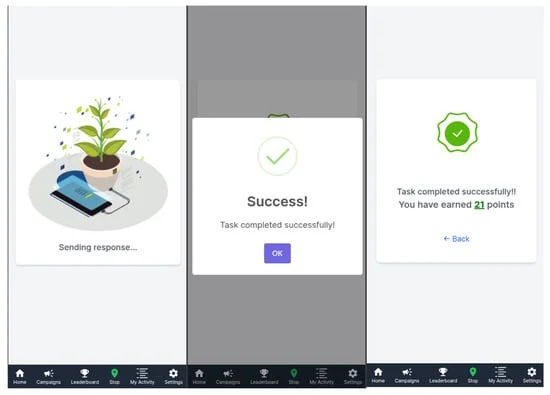 Submitting a completed task and receiving the associated points.
Gamification Elements
Three specific game mechanics were embedded in the platform:
- Points: earned for each completed task
- Daily streaks: bonus rewards for participating on consecutive days
- Real-time leaderboard: an anonymous ranking showing all participants’ scores
The leaderboard preserved privacy by displaying anonymous entries (labelled with “****”) for other users, while still providing meaningful social comparison. Activity charts further let participants see their individual performance relative to the group as a whole.
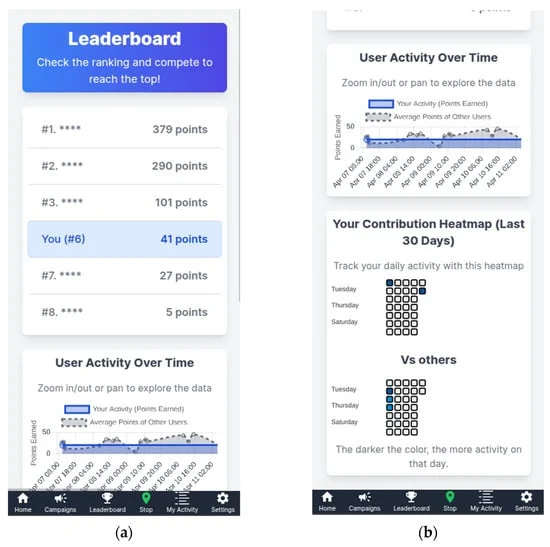 Anonymous leaderboard (left) and individual vs. group activity charts (right).
The experiment combined behavioural logs, validated psychometric scales (GAMEFULQUEST), and post-experiment interviews to analyse both quantitative and qualitative aspects of engagement.
Participation and Engagement
A total of 49 students registered on the platform, with 40 completing a baseline survey. However, as often occurs in voluntary citizen science projects, only a subset became active contributors.
During the five-day intervention:
- 7 participants submitted at least one full set of tasks
- This represents roughly 15% active participation
Although the analytical sample was small, this participation rate aligns with patterns observed in other campus-based citizen science studies.
What the Data Revealed
The results highlight a nuanced picture of how gamification influences engagement.
Strong Effects on Accomplishment and Goal Orientation
Participants reported high levels of accomplishment, indicating that gamified elements helped create a sense of progress and goal-directed activity. The GAMEFULQUEST instrument which captures multiple dimensions of gameful experience, showed that accomplishment scores were consistently higher than immersion scores across all participants.
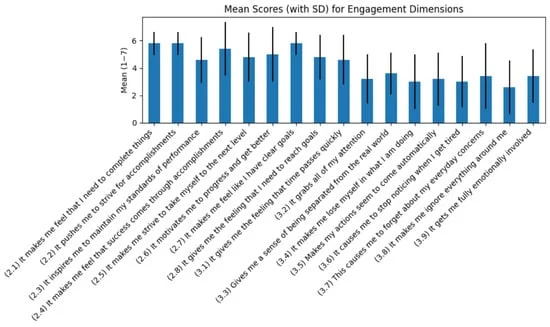 Mean GAMEFULQUEST scores per item: accomplishment dimensions consistently outperform immersion dimensions.
Survey responses showed that participants felt motivated to improve their performance and pursue higher scores, suggesting that points and progress feedback effectively reinforced competence. Notably, participants who completed more tasks reported higher accomplishment scores.
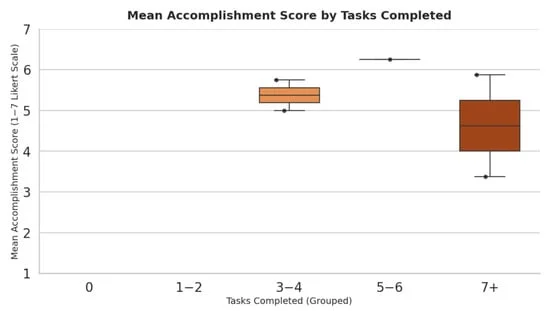 Accomplishment scores grouped by number of tasks completed, showing a positive trend.
More Limited Effects on Immersion
In contrast, the results for immersion and flow were more moderate. While some participants reported feeling deeply engaged with the activity, most experienced only moderate levels of immersion.
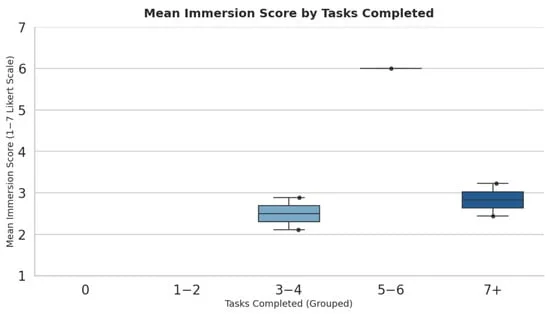 Immersion scores by task completion group - more variability and lower overall levels than accomplishment.
Interviews indicated that the repetitive nature of tasks began to reduce the novelty effect after several days. This suggests that while gamification can enhance motivation, task design remains a critical factor for sustaining deeper engagement.
Engagement Patterns Varied Between Individuals
Psychometric profiles revealed significant variability between participants. Some users reported high engagement despite completing relatively few tasks, while others completed multiple tasks but reported lower emotional involvement.
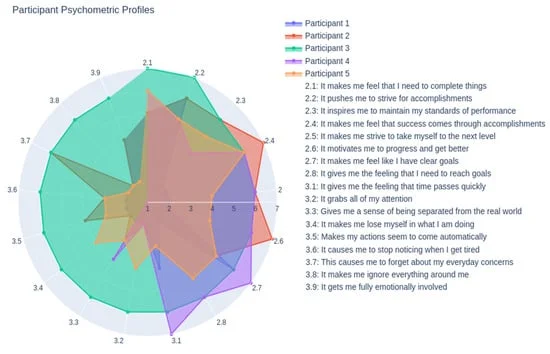 Individual radar profiles on GAMEFULQUEST dimensions - each participant shows a distinct motivational pattern.
These differences highlight the importance of individual motivational factors and personal schedules in shaping participation and point to the need for more personalised gamification approaches.
Insights from Participant Interviews
Post-experiment interviews provided additional context for understanding engagement dynamics.
Several recurring themes emerged:
Curiosity and novelty Participants were initially motivated by the opportunity to take part in a real-world experiment using a digital platform.
Desire to contribute Many students reported that contributing observations that might help improve campus environments was an important motivator.
Recognition and feedback Leaderboards and point rewards helped reinforce participation, although participants emphasized that these were not their sole motivation.
However, participants also identified two important barriers:
- Time constraints related to academic workload
- Repetitive tasks that reduced motivation after the first few days
These findings suggest that gamification alone cannot fully sustain engagement if task structures remain static.
What This Means for Citizen Science Platforms
The study demonstrates that well-designed gamification can enhance early-stage motivation and engagement in spatial crowdsourcing activities, particularly by reinforcing a sense of progress and recognition.
At the same time, the findings highlight several important considerations for future citizen science platforms:
- Gamification should complement, not replace, meaningful tasks.
- Engagement mechanisms must evolve over time to avoid novelty fatigue.
- Participant motivations often extend beyond rewards, including curiosity and the desire to contribute to real-world improvements.
Importantly, the experiment shows that gamification can be integrated into citizen science platforms without undermining data quality, provided that reward mechanisms are carefully aligned with the goals of the project.
Toward More Adaptive Citizen Science Systems
Although the study was exploratory and based on a small sample, it provides valuable methodological insights for future research.
By combining behavioural data, validated engagement scales, and qualitative interviews, the study illustrates how mixed-methods evaluation can reveal the mechanisms behind participation dynamics in citizen science platforms.
These insights can inform the design of next-generation systems capable of balancing three critical objectives:
- Sustained participant engagement
- High-quality environmental data collection
- Inclusive participation across diverse user groups
As citizen science continues to play a growing role in environmental monitoring and urban sustainability initiatives, understanding how to design motivating and resilient participation systems will remain a key research challenge.
This post summarises findings from: Vergara-Borge, F., López-de-Ipiña, D., Emaldi, M., Olivares-Rodríguez, C., Khan, Z., & Soomro, K. (2025). Gamifying Engagement in Spatial Crowdsourcing: An Exploratory Mixed-Methods Study on Gamification Impact Among University Students. Systems, 13(7), 519. https://doi.org/10.3390/systems13070519